Selecting the Right Gear Hob: A Practical Guide for Gear Manufacturers
If you've ever experienced premature hob wear, inconsistent tooth profiles, or unexpected tool failures mid-run, the root cause often traces back to the same place: the wrong hob was selected for the job. Choosing a gear hob isn't simply a matter of matching module and pressure angle. Material, coating, geometry, and application all play critical roles in how long a hob lasts and how well it performs.
This guide walks through the key selection criteria every gear manufacturer should evaluate before placing a hob order.
1. Substrate material: the foundation of performance
The base material of a hob determines its hardness, toughness, and resistance to heat — three properties that are often in tension with one another.
High-speed steel (HSS) remains the workhorse of the industry for good reason. It offers excellent toughness, is more forgiving of interrupted cuts and misalignment, and can be resharpened multiple times without significant loss of geometry. For shops running lower volumes, softer workpiece materials (such as mild steel or aluminum), or older machines with limited rigidity, HSS is often the practical and economical choice.
Within the HSS family, grades matter:
- M2 is the standard general-purpose grade — a good balance of hardness and toughness.
- M35 (5% cobalt) improves hot hardness for tougher alloys.
- M42 (8% cobalt) is preferred for hardened steels, stainless, and high-temperature alloys.
- PM-HSS (powder metallurgy) grades such as ASP 2030, ASP 2052, ASP 2060, S290 and S390 offer a finer, more uniform carbide structure, resulting in longer tool life and better surface finish than conventionally produced HSS.
(CTI hobs are supplied as standard in M2, M35 and the PM-HSS grades above; M42 and solid carbide are quoted on request.)
Solid carbide hobs operate at significantly higher cutting speeds and deliver superior surface finishes, making them well-suited for high-volume production, fine-pitch gears, and hard or abrasive materials. The trade-off is brittleness — carbide is far less forgiving of machine vibration, poor workholding, or operator error. The investment cost is also substantially higher, so the economics only make sense when volume and consistency justify it.
Carbide-tipped HSS is a hybrid approach where carbide inserts are brazed or mechanically fixed to an HSS body. Less common today but still used in specific large-module applications.
2. Coating: extending life and enabling speed
Even the best substrate benefits from a surface coating. Modern PVD (physical vapor deposition) coatings dramatically reduce friction, increase surface hardness, and extend tool life — typically by 3–8× compared to uncoated tools. Choosing the right coating depends on your workpiece material and cutting conditions.
| Coating | Best for | Key benefit |
|---|---|---|
| TiN (titanium nitride) | General purpose, mild steels | Low cost, good wear resistance |
| TiCN (titanium carbonitride) | Cast iron, abrasive materials | Higher hardness than TiN |
| TiAlN (titanium aluminum nitride) | Alloy steels, hardened materials, dry cutting | Excellent hot hardness up to 800 °C |
| AlCrN / Alcrona (aluminum chromium nitride) | Stainless, high-temperature alloys | Superior oxidation resistance |
| Altensa | High-productivity hobbing of case-hardening steels | Long life at high cutting speeds, wet or dry |
| DLC (diamond-like carbon) | Aluminum, non-ferrous | Near-zero friction, prevents built-up edge |
A common and costly mistake is applying a high-performance coating to an unsuitable substrate or running coated tools with flood coolant when they were designed for dry cutting. TiAlN, for example, performs best in dry or minimum quantity lubrication (MQL) conditions — under flood coolant it never reaches the temperature at which it forms its protective aluminum-oxide layer, and on carbide an interrupted coolant stream can also crack the substrate.
3. Hob geometry and design class
Not all hobs of the same module are created equal. Geometry choices significantly affect chip evacuation, surface finish, and tool longevity.
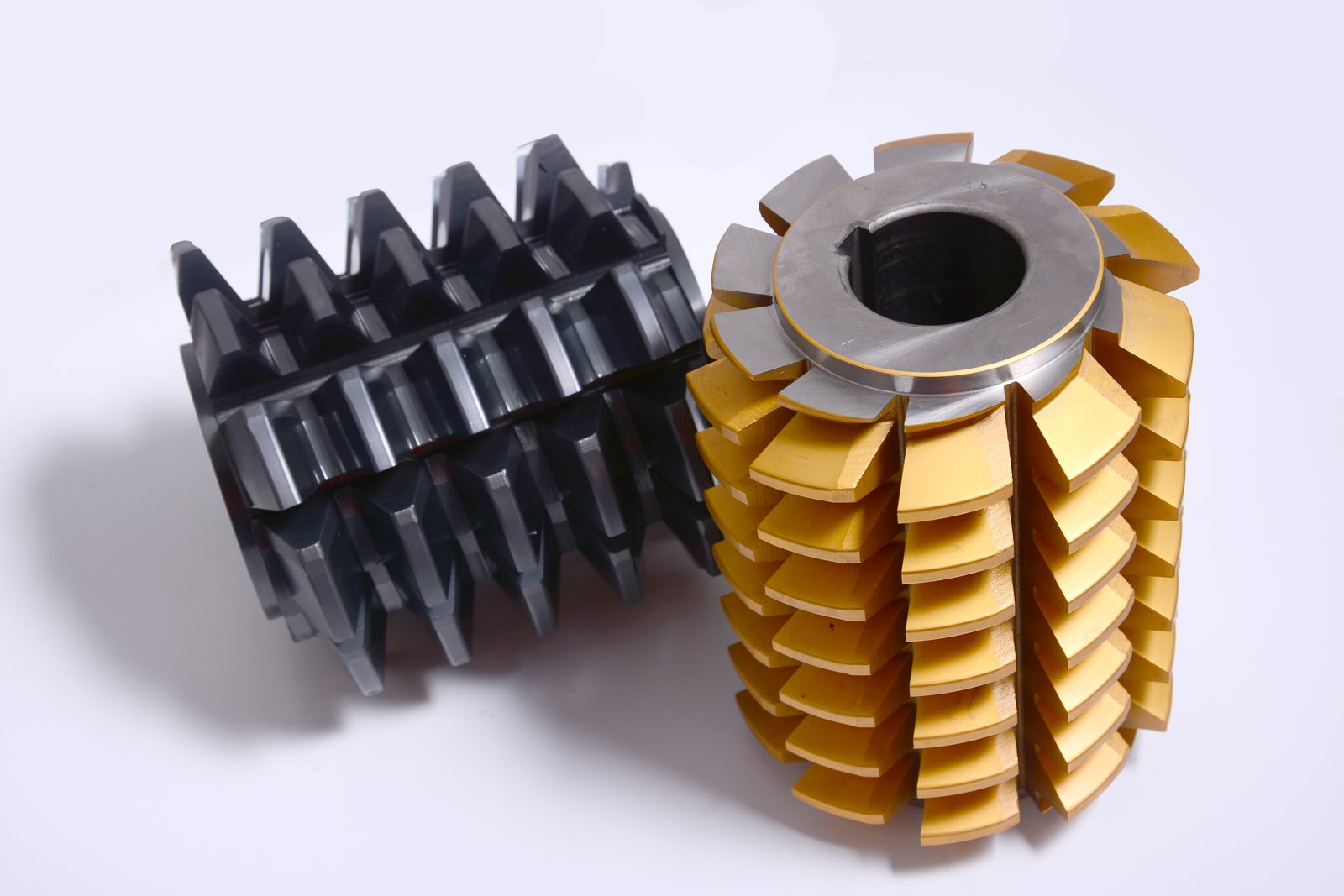
Number of flutes (gashes). More flutes mean more cutting edges and better surface finish, but reduce chip gullet size. Fewer flutes improve chip clearance for roughing and high-feed applications. For finishing passes on fine-pitch gears, higher flute counts are preferred.
Number of starts. Single-start hobs are standard and deliver the most accurate tooth form. Multi-start hobs allow higher table feed rates for productivity gains but at some sacrifice in accuracy — appropriate for roughing or where tight tolerances aren't required.
Relief angle. Higher relief angles reduce cutting forces and heat but shorten resharpening life. Lower relief angles last longer between grinds but generate more heat. This is a balancing act based on your production volumes and resharpening program.
DIN/AGMA class. Hobs are manufactured to accuracy classes — DIN 3968 AA, A or B (the standard also defines C and D for rough work), or equivalent AGMA grades. Always match the hob class to the gear quality you need. Running a class B hob to produce class 6 gears is a false economy; running a class AA hob on roughing operations is an unnecessary expense.
4. Workpiece material considerations
The material you're cutting should drive every other decision:
- Low-carbon and mild steels: standard M2 HSS with TiN or TiCN coating, flood coolant.
- Alloy and tool steels: M35/M42 or PM-HSS with TiAlN or Altensa; consider dry or MQL cutting.
- Hardened steels (up to ~62 HRC): solid carbide with AlCrN, dry cutting, high speed.
- Stainless steel: PM-HSS or carbide with AlCrN; stainless work-hardens quickly, so sharp edges and adequate feed rates are critical.
- Aluminum and non-ferrous: uncoated HSS or DLC-coated tools; avoid TiN, which can cause material adhesion.
- Plastics and composites: uncoated sharp-geometry HSS; heat management is the primary concern.
5. Machine tool and setup factors
A hob is only as good as the machine running it. Before finalizing your selection, consider:
- Machine rigidity: worn spindle bearings or inadequate fixture clamping amplify vibration, destroying carbide tools quickly and reducing HSS life.
- Available RPM and feed range: carbide requires higher cutting speeds to be cost-effective; if your hobbing machine can't reach them, HSS will outperform carbide in practice.
- Coolant system: high-pressure coolant through-spindle changes your coating selection entirely.
- Arbor condition: a worn or improperly seated arbor introduces runout that no hob quality level can compensate for.
6. Resharpening and total cost of ownership
Purchase price is a poor measure of hob value. The real metric is cost per gear produced.
HSS hobs can typically be resharpened 8–12 times before the geometry is exhausted, making them an excellent long-term investment when a proper resharpening program is in place. Carbide hobs can also be resharpened, but require diamond grinding wheels and precise equipment — not all tool grinding shops are equipped for it.
When evaluating total cost, factor in:
- Initial tool cost
- Number of resharpenings available
- Expected pieces per edge
- Resharpening cost per cycle
- Downtime for tool changes
A PM-HSS hob with AlCrN coating running two to three times the pieces per edge and resharpened 10 times will almost always outperform a cheaper uncoated M2 hob on a total cost basis — even at two to three times the upfront price, because the regrind cost and downtime per gear fall with it.
Conclusion
Gear hob selection is a system decision, not a catalog lookup. The right hob matches your workpiece material, machine capability, production volume, and quality requirements as a complete package. Getting one element wrong — running a dry-cut coating with flood coolant, or using a standard HSS hob on hardened steel — undermines the entire investment.
At CTI-USA, we work with gear manufacturers to match the right CTI gear hob specification to the job. Whether you need a standard-specification hob or a custom design for a specific application, we're here to help you get more life and more accuracy out of every tool.
Questions about your specific application? Try the free tool steel and coating selector and hobbing cycle-time estimator, or contact us.
Originally published on LinkedIn.
Richard Potesta is the founder of CTI-USA, the North American sales, engineering and support partner of Capital Tool Industries and distributor for Eifco machines. Questions about an application? Contact CTI-USA or call 330-962-8160.
Need the tool this article describes?
Send us the print. We will specify the cutter or hob, recommend the tool steel and coating, and quote it.